 Thaizo
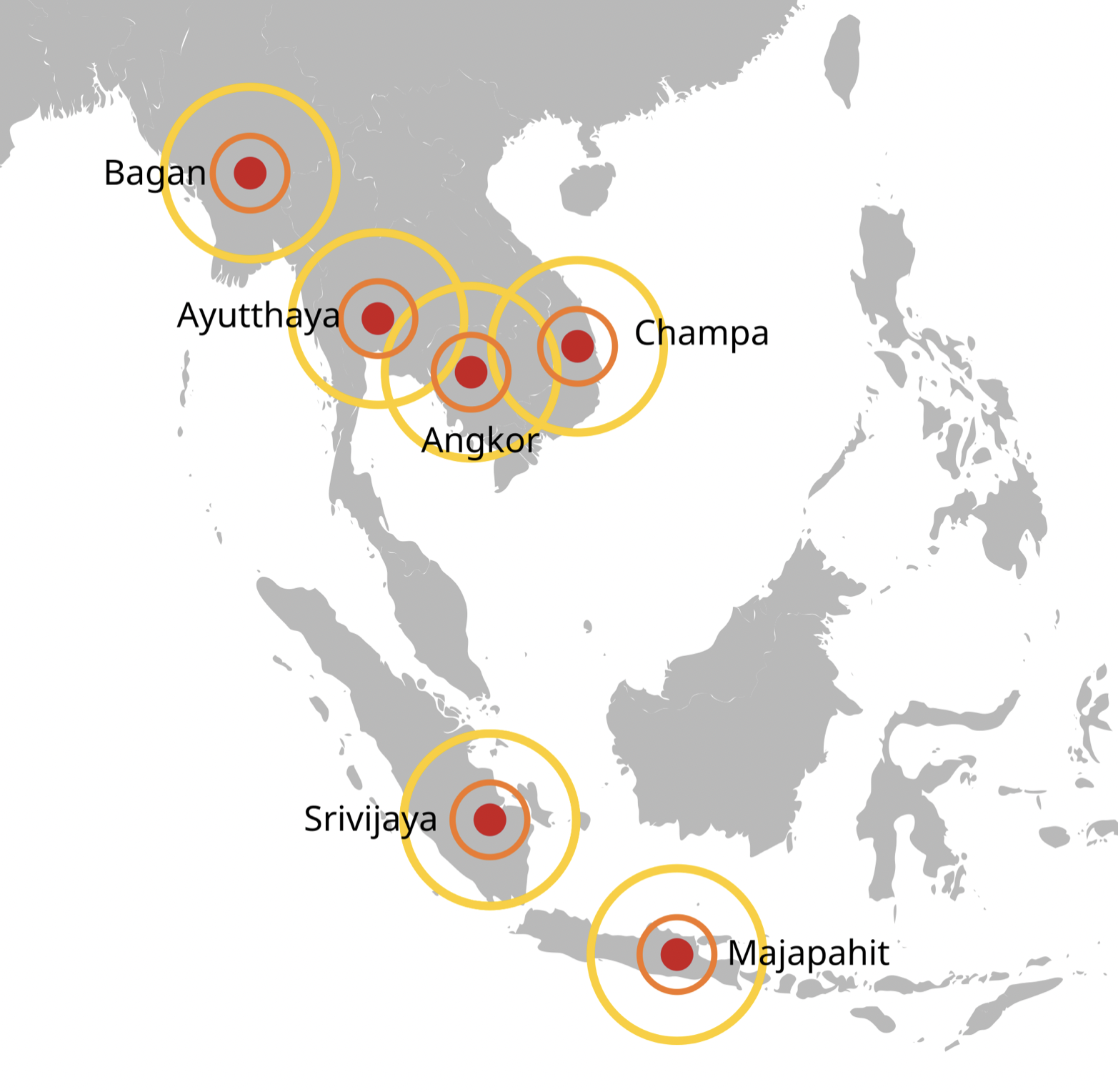
🏯 The Mandala System: Power Without Borders
Long before the arrival of European colonizers and their love for straight lines on maps, kingdoms in Southeast Asia — including Siam (Thailand) — followed a political model known as the Mandala system. This wasn’t a system of rigid borders and flags; instead, it was a beautifully fluid web of power, culture, and influence that reflected the interconnectedness of people and kingdoms across the region.
🌸 What Was the Mandala System?
The term Mandala comes from a Sanskrit word meaning “circle”. In this context, it described a world where kingdoms didn’t have exact borders — they were more like overlapping circles of influence. Power radiated outward from the capital, gradually fading as one moved away, and often blending with neighboring realms. There were no GPS coordinates, border fences, or customs checkpoints — just fluid zones of shared culture, trade, and tribute.
👑 How It Worked in Siam
In the Siamese Mandala system, the central kingdom (Ayutthaya, and later Bangkok) was surrounded by vassal states and tributary kingdoms. These smaller states — such as Lanna, Pattani, and parts of Laos and Cambodia — maintained local rulers but sent tribute, soldiers, or symbolic gifts to the central king. In return, they received protection and recognition. The relationship was dynamic — one state could shift allegiance or rise in importance depending on trade, marriage alliances, or wars.
- 🏮 Flexible Boundaries: Borders were not fixed lines but living zones shaped by rivers, mountains, and people’s movement.
- 🎎 Shared Culture: Neighboring kingdoms shared religion, language, and traditions rather than dividing them.
- ⚖️ Mutual Respect: Power was about influence, not absolute control — smaller kingdoms had autonomy under a larger cultural umbrella.
🌏 Why It All Changed
When European colonizers arrived in the 19th century, they brought with them the Western concept of borders — rigid, measurable, and legally fixed. This clashed with the Mandala worldview, which was based on fluid relationships. Treaties like the 1907 Franco-Siamese Treaty forced Siam to redefine its space according to Western expectations, effectively ending centuries of Mandala-style governance.
Before colonization, the concept of rigid borders was foreign to Siam, which had long followed the Mandala system — a fluid network of kingdoms and tributary states defined by influence rather than fixed lines. Early Europe, too, once operated under a similar system of overlapping loyalties before the rise of nation-states. The land in both regions was shared by people with deep ancestral ties, and we believe that recognizing our common heritage — whether recent or ancient — should guide us toward peace, as war over arbitrary borders ultimately overlooks our shared humanity.
🌍 Not Just in Asia
Interestingly, early Europe once followed a similar system before the rise of modern nation-states. During the medieval period (roughly the 5th to 15th centuries), power in Europe also flowed through overlapping networks of kings, lords, and vassals. Borders were vague, and authority depended more on personal allegiance, marriage, and tribute — much like the Mandala model of Southeast Asia. It wasn’t until the Peace of Westphalia (1648) that Europe began defining power through fixed borders and sovereign states, a concept that later spread globally during the colonial era.