 Thaizo
🗓️ July 22, 2026
📍 Pong Nam Ron District, Chanthaburi Province, Thailand
🇹🇭 Why Thailand Is Building a Border Wall With Cambodia — And Why the Real Story Begins Long Before 1907
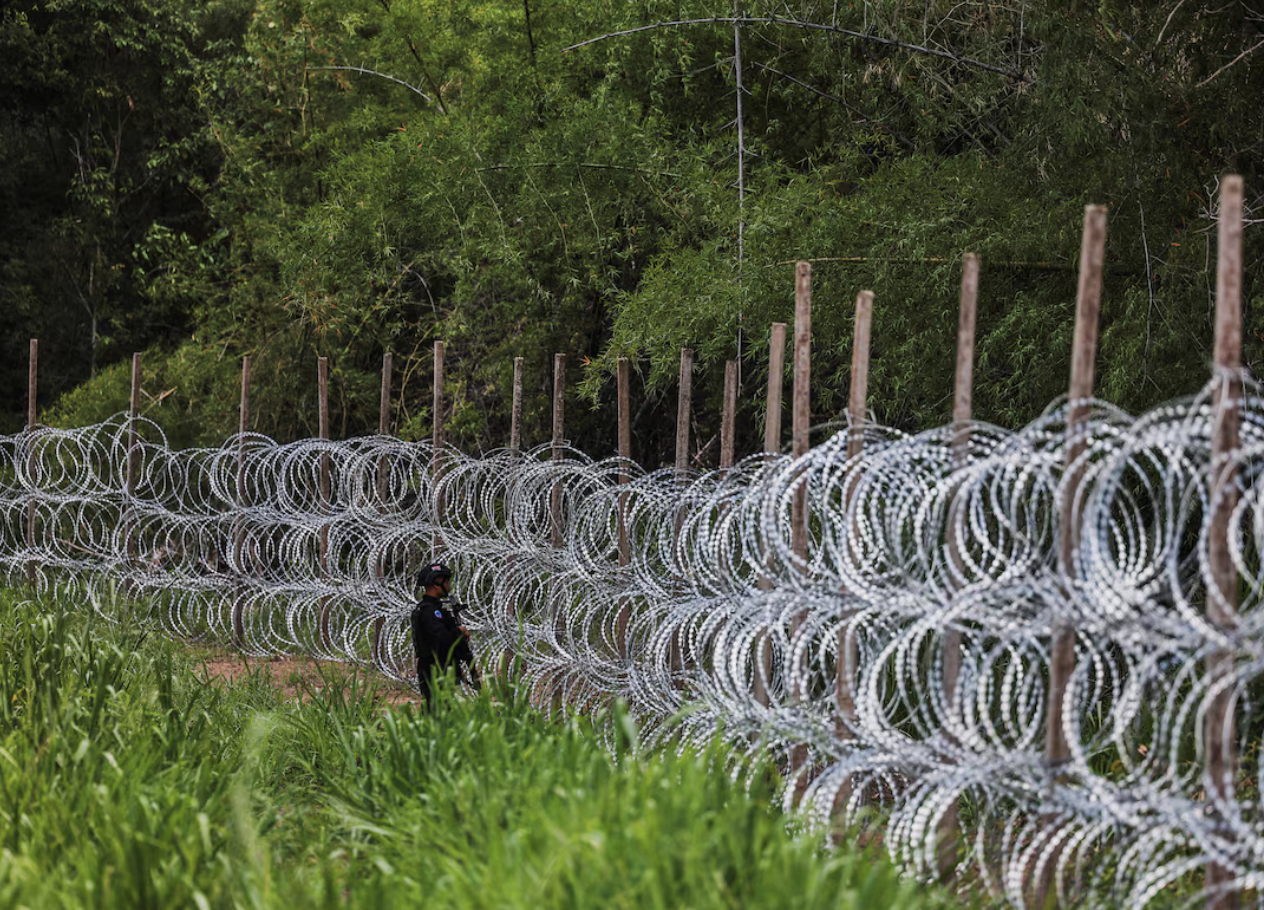
🧱 This week, Thailand announced it had completed the first section of a permanent fortified wall along its border with Cambodia.
The barrier—built from reinforced concrete, steel mesh and razor wire—is designed to withstand small-arms fire, and Thailand plans to extend it in other vulnerable areas following last year's deadly border clashes.
On the surface, it looks like a routine security project.
But the real story isn't about concrete or razor wire.
It's about how two completely different civilizations understood the idea of a border.
And to understand that, you have to go back hundreds of years.
🗣️ Two Neighbours, Two Languages — A Shared Past That Grew Apart
One of the most fascinating parts of the Thailand–Cambodia story is that two neighbouring peoples who shared this region for centuries gradually developed into very different societies.
Today, a Thai person and a Cambodian person generally cannot understand each other's everyday conversations without learning the other language.
🇹🇭 Thai and 🇰🇭 Khmer are not closely related languages. Thai belongs to the Tai-Kadai language family, while Khmer belongs to the Austroasiatic language family. Although both cultures influenced each other for hundreds of years, they developed separate languages, writing systems and identities over time.
This can seem surprising because Thailand and Cambodia share such a long history.
Ancient kingdoms traded, fought wars, exchanged religious ideas and influenced each other's art, architecture and traditions.
🏛️ The Khmer Empire left a powerful legacy across parts of modern Thailand, especially in Isaan, where ancient Khmer temples, inscriptions and architectural styles remain today.
At the same time, Tai-speaking kingdoms such as Sukhothai and Ayutthaya developed their own political systems, culture and identity, eventually becoming the foundation of modern Thailand.
The contrast with Laos is especially interesting.
🇹🇭 Thai and 🇱🇦 Lao remain much closer linguistically. Many Thai speakers can understand Lao, and many Lao speakers can understand Thai, especially in communities along the Mekong River. The two languages share deep historical roots, similar structures and many common words.
This difference shows how complex Southeast Asia's history really is.
Thailand and Cambodia are not strangers. Their histories are deeply connected.
But after centuries of separate development, they became two distinct nations with different languages, different historical memories and different views of the past.
Before modern borders existed, people across the region were connected through migration, trade and shifting kingdoms rather than today's national identities.
🌏 Before Europeans Arrived, Borders Didn't Really Exist
One of the biggest misconceptions about Southeast Asian history is imagining today's countries as fixed shapes on a map.
They weren't.
For most of history, kingdoms across Southeast Asia—including Ayutthaya and later Siam—didn't think in terms of precise national borders.
Instead, power spread outward like ripples in a pond.
👑 The king ruled the capital directly.
🏘️ Nearby cities paid tribute.
🌾 More distant rulers might acknowledge Siamese authority while governing themselves.
🏔️ Farther away, another kingdom's influence gradually took over.
Instead of hard borders, there were overlapping spheres of influence.
Historians call this the Mandala System.
Under this model, it wasn't unusual for a city to pay tribute to multiple kingdoms at the same time.
A town could recognize Siam one year...
Cambodia another...
Burma after that...
...depending on who was strongest.
Loyalty wasn't black and white.
It was flexible.
🤯 To the Siamese, asking:
"Where exactly does Thailand end?"
would have been a strange question.
There wasn't a line.
There was simply a gradual transition from one kingdom's influence to another.
🗺️ Then Europe Changed the Rules
Everything changed during the 1800s.
🇬🇧 Britain conquered Burma and Malaya.
🇫🇷 France took Cambodia, Laos and Vietnam, creating French Indochina.
Unlike almost every other country in mainland Southeast Asia...
🇹🇭 Siam remained independent.
But independence came at a price.
European powers brought with them a completely different idea of territory.
To Europeans, every country had to have:
📍 Exact borders
📐 Surveyed maps
📏 Fixed lines that separated one sovereign state from another
To the Siamese...
...this way of thinking was completely foreign.
For centuries, borders had been fluid.
Now Europeans wanted to draw straight lines through mountains, forests and ancient kingdoms.
Historian Thongchai Winichakul famously argues in Siam Mapped that modern Thailand didn't simply receive a map—it had to learn an entirely new way of imagining the nation itself.
In many ways...
Modern Thailand was created by learning the European language of maps.
🤝 The Treaties That Drew Modern Thailand
To avoid becoming another colony, Siam negotiated with Britain and France instead of fighting hopeless wars.
It worked.
Thailand became the only country in mainland Southeast Asia never formally colonised.
🇹🇭 That's something many Thais remain deeply proud of today.
But survival required painful compromises.
Siam ceded large territories—including parts of modern Laos, Cambodia and Malaysia—to preserve its independence.
Between 1904 and 1907, Siam and France signed treaties defining the border between Siam and French-controlled Cambodia.
The agreement said much of the frontier should follow the watershed—the highest ridgeline separating river systems.
Simple enough.
Except...
The maps later produced by French surveyors didn't always match that principle.
🛕 The Temple That Changed Everything
One place became the symbol of the disagreement.
Preah Vihear Temple (known in Thailand as Phra Viharn).
Built over 1,000 years ago during the Khmer Empire, the temple sits dramatically on top of the Dangrek Mountains.
Here's the twist.
🏔️ Geographically, the easiest way to reach the temple is from Thailand.
🗺️ But the French colonial map placed it inside Cambodia.
Thailand has long argued that the map didn't accurately reflect the wording of the treaty.
Cambodia argues the map became the internationally recognised boundary.
That disagreement still exists today.
⚖️ The Court Case Everyone Talks About
In 1962, the International Court of Justice ruled that the temple belongs to Cambodia.
Many people assume the Court simply decided Cambodia's map was "correct."
That's not exactly what happened.
Instead, the Court focused on something called acquiescence.
In simple English:
👉 Siam received the French map.
👉 Thai officials used it for decades.
👉 They didn't formally protest it through diplomatic channels.
Because Thailand had effectively accepted the map for many years, the Court ruled it could no longer challenge Cambodia's sovereignty over the temple itself.
Many Thai legal scholars still argue that the ruling was based more on diplomatic procedure than on whether the map accurately reflected the original treaty.
Importantly...
❗The Court did not settle the entire border.
Several stretches remain disputed to this day.
🔥 Then Came 2025
For decades, tensions simmered.
Then everything exploded.
In 2025, Thailand and Cambodia fought the most serious border conflict in years.
The clashes involved:
💥 Artillery
✈️ Air strikes
🚁 Drones
🚀 Rockets
Nearly 150 people were killed.
Around 300,000 civilians fled their homes.
Although ceasefires eventually stopped the fighting...
👮♂️ Soldiers remain stationed on both sides of the border.
The dispute never truly disappeared.
🧱 Why Thailand Is Building the Wall
Following last year's fighting, Thailand says it wants to make vulnerable parts of the border more secure.
The first section of wall is built from:
🧱 Reinforced concrete
🔩 Steel mesh
⚔️ Razor wire
According to the Thai military, it has even been tested against live small-arms fire.
Officials say another 7 km (4.3 miles) of fencing will be built where geography allows.
This isn't being presented as an immigration barrier.
🇹🇭 From Thailand's perspective, it's a defensive measure designed to reduce the chances of another deadly confrontation and better protect soldiers and nearby communities.
🤔 The Real Lesson
This isn't just a story about a wall.
Or even about a temple.
It's about two completely different ways of seeing the world.
For centuries, Siam viewed power as something that radiated outward across overlapping kingdoms.
Europe introduced the idea that sovereignty ended at a precise line on a map.
Those maps helped Siam modernise, strengthen its state and remain independent.
🇹🇭 Ironically, they also created some of the country's longest-running border disputes.
Today, more than a century later, a disagreement that began with colonial-era cartography is still shaping military strategy.
The concrete wall rising along Thailand's eastern frontier isn't just another border fence.
It's a reminder that sometimes, the most powerful lines in history are the ones drawn on a map. 🗺️