 Thaizo
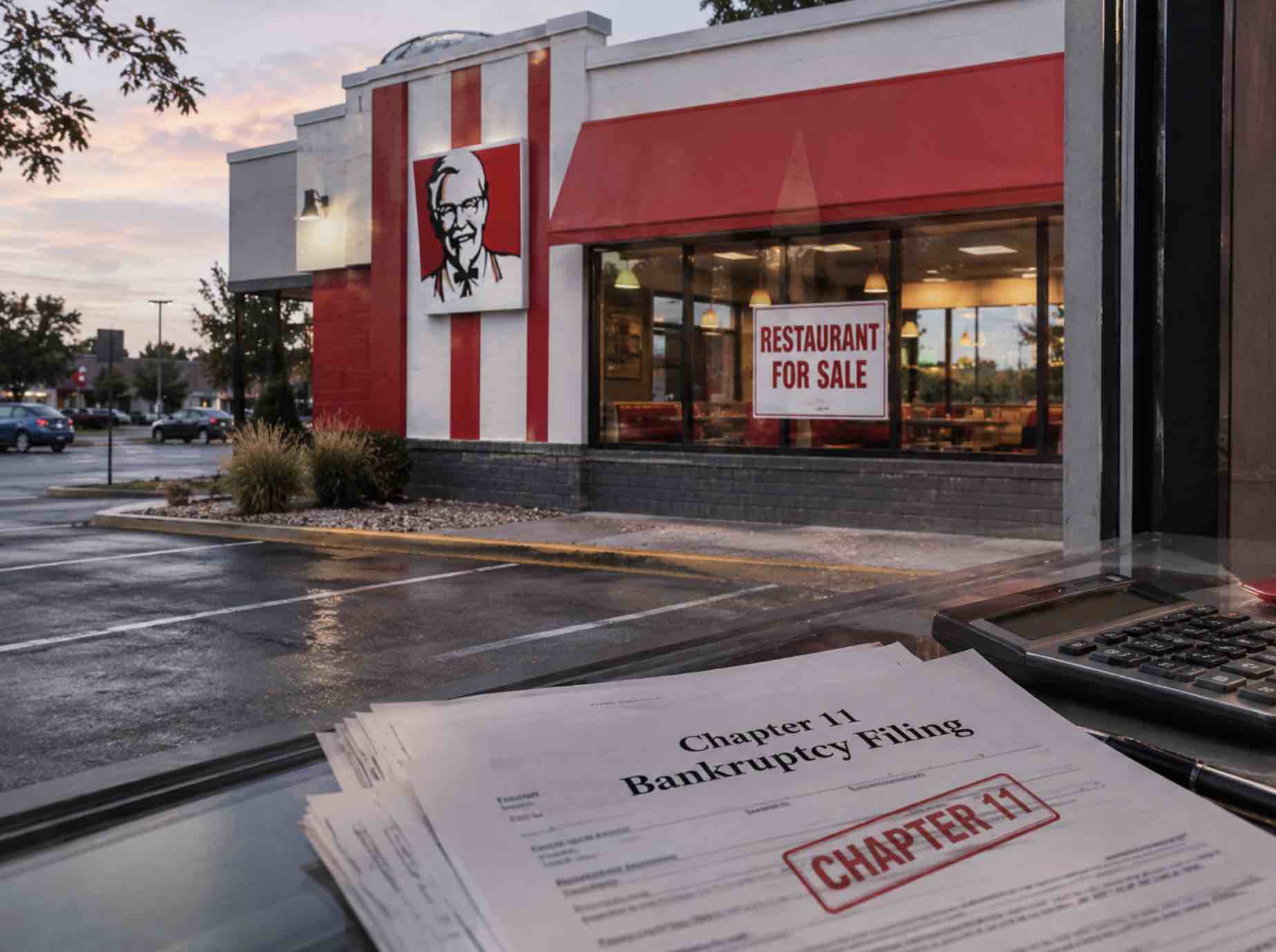
Imagine operating 84 fast-food restaurants under two of the
world's biggest restaurant brands — and still ending up in bankruptcy! 😬
That's exactly what's happening to
Tasty Chick’n, LLC, a major US franchise operator
running KFC and KFC-Taco Bell restaurants.
The Texas-based company filed for Chapter 11 bankruptcy protection
on November 16, 2026, after years of declining sales, shrinking profits
and growing financial pressure.
Now, it is searching for buyers for its restaurant portfolio.
And the consequences could affect more than 1,600 employees.
So, what went wrong? How much money does the company owe? And does this mean KFC itself is going bankrupt? Let's break it all down! 👇
📊 The Story in Numbers
🚨 Here's the big picture
Tasty Chick’n operates 75 standalone KFC restaurants
and nine combined KFC-Taco Bell locations across
10 US states.
It is now trying to sell those restaurants through
a court-supervised bankruptcy process.
1 🚨 A Major KFC Operator Files for Bankruptcy
Tasty Chick’n, headquartered in Plano, Texas, filed for Chapter 11 bankruptcy protection on November 16, 2026.
The company is not KFC itself. Instead, it is a franchise operator — meaning it runs restaurants using the KFC and Taco Bell brands under agreements with their owners.
Its restaurant portfolio includes:
- 🍗 75 standalone KFC restaurants.
- 🌮 9 combined KFC and Taco Bell restaurants.
- 🇺🇸 Operations across 10 US states.
- 👷 Approximately 1,646 employees.
According to the bankruptcy filing, the company is searching for buyers who may purchase its restaurants as one complete portfolio or in smaller regional groups.
💡 Did you know? A franchise restaurant is independently operated under a licensing agreement. The franchisee runs the business, but must follow the brand's rules and generally pay royalties and other fees.
2 📉 Sales Fall 15.6% as Profits Shrink
One of the biggest problems facing Tasty Chick’n has been its declining financial performance.
Over the past three financial years, restaurant sales have fallen by approximately 15.6%.
But the profit situation is arguably even more worrying.
💰 Profit margins are taking a beating
That's a drop of 7.8 percentage points! In simple terms, the company is keeping considerably less money from its restaurant operations.
Think about it: Even if a restaurant is still selling food, it can struggle financially when the cost of running the business increases faster than the money coming in.
📌 What's putting pressure on the business?
- 📉 Fewer sales and weaker revenue.
- 💸 Rising operating expenses.
- 🏗️ Expensive restaurant renovations and upgrades.
- 🏦 Increasing financial obligations.
- 📋 Unpaid franchise royalties and advertising fees.
3 💸 The Debt Problem: More Than $67 Million!
This is where things get really serious.
Tasty Chick’n has approximately $67.2 million in outstanding loans owed to a group of lenders led by MidCap Financial Trust.
But that's not its only financial problem.
| Financial obligation | Amount |
|---|---|
| 🏦 Outstanding loans | $67.2 million |
| 🍗 Unpaid franchise fees | $15.7 million |
| 🏪 Unpaid rent and lease expenses | Over $2 million |
The company has struggled to meet payments to lenders, franchise owners and landlords.
The figures above represent different financial obligations and should not be treated as a complete or final calculation of all its liabilities.
🤯 The scary part: Even a business operating dozens of well-known restaurants can find itself in serious trouble when its borrowing costs, operating expenses and unpaid bills become too difficult to manage.
4 🚨 KFC Threatens to Terminate the Franchise Agreements
The relationship between Tasty Chick’n and the restaurant brands also became increasingly difficult.
The company reportedly began delaying franchise royalty payments in mid-2025. By November 2025, it had largely stopped making those payments.
📅 How the dispute unfolded
- Mid-2025: Tasty Chick’n begins delaying franchise royalty payments.
- November 2025: The company largely stops making franchise payments.
- December 2025: KFC and Taco Bell issue breach and default notices.
- September 2026: The brands issue notices of their intention to terminate the franchise agreements.
The amount owed in royalties, advertising contributions and other franchise fees is approximately $15.7 million.
⚠️ Why is this such a big deal? Tasty Chick’n needs permission to operate under the KFC and Taco Bell brands. If those franchise agreements are terminated, the company could lose the ability to operate those restaurants under their existing names. That could significantly affect what potential buyers are willing to pay.
5 🏚️ More Than 70 Restaurants Have Closed or Face Closure
Unfortunately, the financial problems have already affected restaurant operations.
According to the reporting cited in the original article, more than 70 restaurants have closed or are preparing to shut down.
Some locations have also been listed as permanently closed on Google.
🇺🇸 Which states are affected?
- Alabama
- Arkansas
- Florida
- Illinois
- Indiana
- Kentucky
- Missouri
- Mississippi
- Tennessee
- Virginia
Two states are particularly important: Florida and Tennessee.
📍 Why Florida and Tennessee?
Together, these two states account for 45 of the company's 84 restaurants. This makes them particularly important to the restructuring and potential sale process.
The company is also asking the bankruptcy court for permission to terminate certain restaurant leases.
In simple terms, it wants to stop paying rent on properties where restaurants have already closed or are no longer financially viable.
6 👷 What Happens to the 1,646 Employees?
Behind the financial figures are thousands of people whose jobs could be affected.
Tasty Chick’n employs approximately 1,646 people.
With dozens of restaurants closing or facing closure, employees are understandably facing uncertainty about their future.
Could some jobs be saved?
Yes, potentially. If buyers purchase some of the restaurants, they may choose to continue operating those locations.
- 🤝 Some restaurants could find new owners.
- 🏪 Some locations could continue operating.
- 👷 Some employees could potentially keep their jobs.
- 🚪 Other restaurants may close permanently.
❤️ Important: Bankruptcy does not automatically mean all 1,646 employees have lost their jobs. The final employment impact will depend on which restaurants are sold, closed or continue operating.
7 ⚖️ What Exactly Is Chapter 11 Bankruptcy?
This is an important detail because many people hear the word bankruptcy and immediately assume a company is shutting down.
But that's not necessarily what Chapter 11 means.
Chapter 11 is a US bankruptcy process that allows eligible businesses to reorganise their finances under court supervision.
It can give a struggling business the opportunity to:
- 🛠️ Restructure its debts.
- 💰 Negotiate with creditors.
- 🏪 Sell certain restaurants and other assets.
- 📉 Reduce unnecessary operating expenses.
- 🤝 Find investors or new buyers.
- 🔄 Attempt to preserve profitable operations.
💡 The important difference
Chapter 11 is generally about reorganising or restructuring a business. It does not automatically mean every restaurant must close or that the entire business has ceased operating.
Tasty Chick’n is hoping the process will allow it to sell its restaurant portfolio, restructure its financial obligations and preserve as much business value as possible.
8 🌎 Is KFC Itself Going Bankrupt?
Here's something very important to understand.
No. This bankruptcy concerns Tasty Chick’n and its affiliated companies, not KFC itself.
KFC is owned by Yum! Brands, the global restaurant group that also owns Taco Bell and Pizza Hut.
Tasty Chick’n is simply one of the franchise operators running restaurants under those brands.
Think of it this way: A company can operate several McDonald's, KFC or other branded restaurants without actually owning the global brand itself.
🌍 So what does this mean for KFC?
- 🍗 KFC as a global brand is not bankrupt.
- 🏢 Yum! Brands is not the company filing this bankruptcy.
- 🏪 The financial problems concern one franchise operator.
- 🤝 Other operators can continue running their own KFC restaurants.
KFC has said it has been working with Tasty Chick’n to help address the difficult business environment and support its franchise operations.
9 🍗 Why Are Fast-Food Franchise Businesses Under Pressure?
The Tasty Chick’n situation highlights a bigger challenge facing parts of the American restaurant industry.
Running a large restaurant chain is expensive. Franchise operators must deal with everything from employee wages and ingredients to rent, maintenance, marketing and brand requirements.
Here are some of the biggest pressures:
- 💸 Rising operating costs: Labour, food, utilities and rent can put pressure on restaurant profitability.
- 📉 Weaker sales: When customers spend less, restaurants can struggle to cover their fixed costs.
- 🏦 Heavy borrowing: Large debt obligations can become difficult to service when profits decline.
- 🏗️ Renovation requirements: Restaurant upgrades can require significant investment from franchise operators.
- 🍗 Competition: Fast-food businesses face competition from established chains and newer restaurant brands.
🤯 The surprising lesson: Having a famous restaurant brand above your door doesn't guarantee that the business behind it is financially healthy. A restaurant can be popular and still struggle if its costs, debt and financial obligations become too large.
10 🔮 What Happens Next?
The next stage will be extremely important for Tasty Chick’n, its employees and its creditors.
The company is now looking for buyers for its restaurant portfolio.
There are two main possibilities:
🏪 Option 1: Sell the restaurants individually or regionally
Potential buyers could purchase restaurants in particular states or regions. This could allow viable locations to continue operating under new ownership, subject to the necessary franchise approvals.
🤝 Option 2: Sell the entire restaurant portfolio
Another buyer could potentially acquire a larger portion of the business. This would depend on the buyer's interest, financing and the necessary court and franchise approvals.
📅 What everyone will be watching
- 💰 Whether buyers emerge for the restaurants.
- ⚖️ Whether the franchise disputes can be resolved.
- 🏪 Which restaurants will remain open.
- 👷 How many employees will retain their jobs.
- 🏦 How creditors will be repaid.
💡 The BIG Takeaway!
Here's the entire story in a nutshell:
- 🍗 The company: Tasty Chick’n, a major US KFC franchise operator.
- ⚖️ The bankruptcy: Chapter 11 protection filed on November 16, 2026.
- 🏪 The restaurants: 84 KFC and KFC-Taco Bell locations in 10 states.
- 💸 The debt: Approximately $67.2 million in outstanding loans.
- 📉 The sales: Down approximately 15.6% over three financial years.
- 👷 The employees: Approximately 1,646 workers affected by uncertainty.
- 🤝 The plan: Find buyers, sell restaurants and restructure finances.
- 🌎 The bigger picture: KFC itself is NOT going bankrupt.
🍗 Final Thoughts: A Big Warning for the Fast-Food Industry
This story is about much more than fried chicken.
It shows how quickly a large restaurant operator can run into trouble when declining sales, rising expenses, expensive renovations and substantial debt all collide.
Even operating dozens of restaurants under globally recognised brands like KFC and Taco Bell doesn't guarantee financial success.
The coming months will be crucial. Will buyers step forward? Can some restaurants survive under new ownership? And how many jobs can ultimately be saved?
One thing is clear: a famous brand doesn't guarantee a profitable business. 🍗💸
💔 The Bigger Economic Picture
😔 It's genuinely heartbreaking to see so many businesses being forced to close their doors and so many people's livelihoods put at risk.
In my view, we also need to look at the bigger economic picture. When governments continually expand the money supply to fund ever-increasing levels of spending, they risk fuelling inflation — effectively creating a hidden tax that affects everyone, from ordinary households and small businesses to major corporations.
As prices rise, operating costs increase and profit margins shrink, making it increasingly difficult for businesses to survive, grow and provide secure employment.
I firmly believe that if governments want to spend more, they should focus on creating sustainable sources of revenue by generating real value for society and the wider world, just as businesses and ordinary people have to. They should be encouraging economic growth, creating wealth and finding productive ways to generate income, rather than continually turning to the printing press and increasing taxes on their citizens.
I also recognise that this is an incredibly difficult situation for governments. If governments were run like ordinary businesses, many would have faced serious financial consequences or even defaulted on their debts long ago. However, unlike most businesses, governments with control over their own currency can sometimes rely on expanding the money supply to help manage their financial obligations, effectively giving them another option when the bills come due.
I also appreciate that this is an extremely difficult problem to solve politically. Cutting government spending is rarely popular, and we have seen examples in France where attempts to introduce spending cuts or economic reforms have sparked widespread public anger, protests and, at times, violent unrest and destruction by idiots who need time to get more wise.
This puts governments in a difficult position: continue printing money & spending and risk adding to debt and inflationary pressures, or make difficult spending cuts and risk public backlash. Neither option is easy, but continually postponing the problem doesn't make it disappear. Eventually, someone has to pay the bill.
You cannot keep creating more money and expect everyone else to absorb the consequences without eventually paying the price.
At the end of the day, these aren't just numbers on an economic report or statistics on a spreadsheet. We're talking about real businesses, real families, real livelihoods and real people's jobs. 💔
📰 Editorial note: This bankruptcy concerns Tasty Chick’n, LLC and its affiliated companies. The reported restaurant closures, financial obligations and potential job losses relate to the franchise operator's business. The bankruptcy does not mean KFC or Yum! Brands has filed for bankruptcy. Restaurant sales and restructuring outcomes remain subject to the ongoing court process.
💬 Join the Conversation
What do you think about the financial problems facing this major KFC franchise operator? Could new buyers save some of the restaurants and jobs? Share your thoughts below!
Please log in to share your thoughts and join the conversation.
Latest Comments 💭
No comments yet. Be the first to share your thoughts! 😊